
Data Governance

The University of Michigan has a long-standing data stewardship program. Governed by Institutional Data Stewardship Policy (SPG 601.12), the program plays a vital role in supporting access to and sharing of institutional data, which is at the core of U-M’s academic and research missions.

Data Governance Goals

Data Access

Increase visibility; improve accountability and process outcomes; meet security, privacy, compliance, and appropriate use requirements.

Data Quality and Use

Document data sets; align data definitions across data sources; establish roles and responsibilities; provide guidelines for data maintenance and use.

Data for Decision Making

Define management needs; establish data definitions, sources, and transformation rules; build common understanding and support across U-M.

Data Governance at U-M

The university uses a data governance model that supports the management of institutional data as a shared strategic university resource.

This structured approach enables data trustworthiness, data-informed insights, and data literacy and culture in support of institutional goals and data strategy.
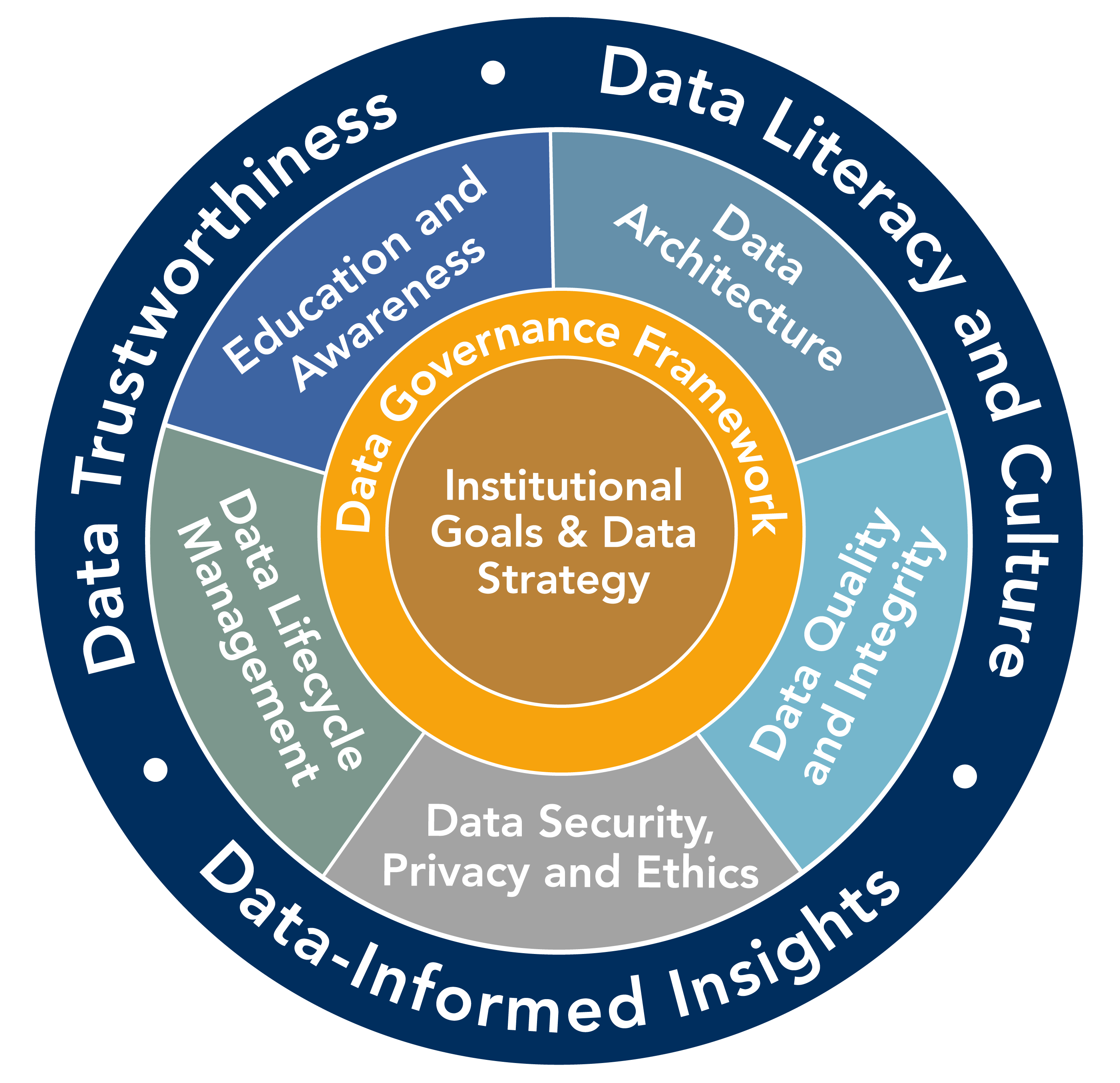
U-M Data Governance Model

Data Governance at U-M supports the university mission and vision, and is directly informed and directed by university goals and data strategy.

Cohesive data strategy is the foundation for effective data governance. A data strategy is a comprehensive plan aligning data collection, storage, management, analysis, and usage with the institution's overall mission and vision. The strategy is guided by overarching principles for stewardship of institutional data, defined in SPG 601.12:

  • Manage information as a strategic university asset by following the University's data governance framework and processes;
  • Promote integrity, consistency, quality, reliability, and accessibility of institutional data;
  • Pursue ethical principles of fairness, privacy, transparency, and accountability throughout the lifecycle of institutional data.

Specific and measurable success criteria and performance indicators will be used to evaluate alignment of the data governance program with university goals, measure and report progress, and inform decisions on data governance priorities.

The U-M data governance framework defines roles and responsibilities and establishes data governance processes, policies, and solutions.

Data architecture is the strategic framework that defines how U-M organizes, stores, integrates, and manages its data assets. It is the blueprint for institutional data that includes data definitions and models that bridge the gap between business needs and technology infrastructure.

It is the operational backbone of data governance providing the technical structures and pathways that make policies enforceable and practical. It embeds standards into systems, automating compliance controls and creating the technical conditions for trustworthy, accessible institutional data.

Data quality and integrity refer to the trustworthiness, accuracy, and reliability of institutional data throughout its entire lifecycle. A well-defined architecture ensures that data elements have consistent definitions and formats across systems to avoid having multiple versions of truth across disconnected databases.

Creating standards for data hygiene help ensure data quality and integrity. Data hygiene is the practice of keeping organizational data clean, accurate, consistent, and reliable through ongoing processes like cleaning, standardizing, and validating records to eliminate errors, duplicates, and outdated information, ensuring data is trustworthy and usable for better business decisions and operations.

Effective data stewardship includes standardized definitions, validation rules, regular auditing, and a culture where accuracy matters.

Data lifecycle management is the comprehensive approach to overseeing institutional data from its initial creation or acquisition through its eventual archival or deletion. It recognizes that data has distinct phases that each require different handling, storage, security, and governance practice.

Successful lifecycle management requires:

  • Clear institutional policies defining retention requirements for different data categories
  • Automated processes where possible
  • Regular training so data stewards understand their responsibilities
  • Periodic audits to ensure compliance
  • Executive commitment that prioritized data stewardship despite competing demands.

Institutional data at U-M is protected through mature university-wide Information Assurance and Privacy programs, rooted in a shared responsibility to safeguard digital assets, comply with applicable laws and regulations, and uphold ethical values and civil liberties.

Data Stewards, Data Custodians, and Data Governance leaders play an important role in ensuring the security, privacy, and appropriate use of institutional data:

  • Comply with data protection and privacy policies and standards.
  • Assess data sensitivity levels and ensure appropriate security and privacy controls are in place.
  • Oversee the integrity and appropriate and ethical handling of institutional data throughout its lifecycle.
  • Promote best data security and privacy practices across users of institutional data.
  • Engage with ITS Information Assurance and the ITS Privacy Office to ensure the security and privacy of institutional data.

Creating awareness and providing education on the principles, practices, policies, and cultural significance of data governance are central to the successful management of institutional data as a strategic university resource.

Data Stewards, Data Custodians, and Data Governance leaders are engaged in a number of activities in support of this component of the U-M Data Governance Model:

  • Actively participate in the development of training resources and awareness materials.
  • Complete required training and invest in ongoing development of data governance knowledge and skills.
  • Cascade key messages from Data Governance Sponsors and Steering Committee and support data governance awareness campaigns.
  • Promote Data Governance across U-M and beyond.

Data Governance Revitalization

To learn more about the history of data governance at U-M and the revitalization efforts that led to the development of the current Data Governance model and framework, visit the data governance revitalization page.